Showing posts with label mardi naythons. Show all posts

Sunday, August 27, 2023

A Challenge for 2023 Part 2

You don't need a challenge for a weaver to want to "shake things up".  What follows are interpretations of the same threading draft and the weaver's comments about their take on the challenge. As expected, no two experiments are the same.

I've taken some of the text posted on the display board from the fair and added a few thoughts of my own.

The Basics of Weaving
The patterns for weaving come from three components: the threading, tie-up and treadling.  Any combination of those three items will affect the outcome of the woven item.  In each example, the threading was kept the same or enlarged for the project, but the tie up and sometimes the treadling was changed.  In the five works, see if you can pick out what is the same and what is different. 

Mardi Naythons
Since this was the first time that I worked with advancing and point twill together, I decided to use the original threading as noted.  It is a smaller sample because of that.  It has only 396 threads.  The treadling is tromp-as-writ.  The one thing that I did do to make it somewhat mine was to make an ice dyed warp in sections.  I tried to make the outer areas the same and I jogged the
middle section in the dye bath so that it would be different.

Ingrid Knox
I took the original threading and extended it to the width I needed for a towel.  I created two different random stripe patterns for the two areas with different threading designs.  The tie-up is a 1-1-1-1-2-2 pattern.  This towel used a tromp-as-writ treadling – that means I used treadles that mirrored the threading.  The towel was woven using 10/2 cotton for the warp and weft.  The sett is 30 epi.


Jeanne Doty
There were so many weaving possibilities in this weaving draft.  Beryl Moody provided us with 37 different tie ups.  Since it was difficult to choose just one, I chose 5 and made a scarf instead of 5 towels.  It was fun to see these different drafts right next to each other.  The warp was maroon 8/2 tencel with a lemon green 8/2 tencel weft.  Each draft made changes to the color play, some bringing the warp color forward while another draft would bring the weft color forward.


Wendy-Marie Teichert
What was fun about this project was seeing how much variety could be achieved simply by changing the tie-up. I experimented with different weft colors – light purple, light yellow, blue and rose – to contrast with the dark purple warp. In retrospect, I think the weavings would have been more successful if I’d kept the weft color constant and varied the warp colors instead.

Beryl Moody
Weavers are always looking for a way to express their own ideas in the items they choose to weave.  This weaving draft was ripe for an adventure.  Having woven it nineteen years ago in a rather straightforward manner, I was thinking about what changes I could make this time around.  

I decided that if I were to alternate colors in certain sections of the warp and then weave that warp with alternating colors this could change the appearance of the final textile, yet have it retain some of the original design.  This method (in weaver's vernacular) is called color-and-weave. Where there are alternating color changes they tend to obscure the original design and give you something with an entirely new look.  The towel I wove is a combination of the original draft showing through, along with sections of color interplay that distort that original pattern. 


Here is a photo of one of the original towels woven 19 years ago.  It is tromp-as-writ and resembles a ripe banana - thus the addition of the fruit!


Wednesday, August 23, 2023

Nevada County Inspired Part 2

 A couple more Nevada County Inspired pieces were woven by Not 2 Square weavers.

Mardi Naytons inspiration was a wonderfully designed twill towel.

I took this photo on a morning walk down my road.  The colors were a summer inspiration that led me to weave this towel.


 Eileen Lee designed and wove this lovely twill block shawl.  We don't have the inspiration for this post, but the shawl speaks for itself.  I believe the photo attached says "Nevada City in the Fall" and the colors certainly reflect that. 


Monday, August 29, 2022

More Weaving at the County Fair

 More Not 2 Square Weavers displayed their woven pieces at the Fair this month.  

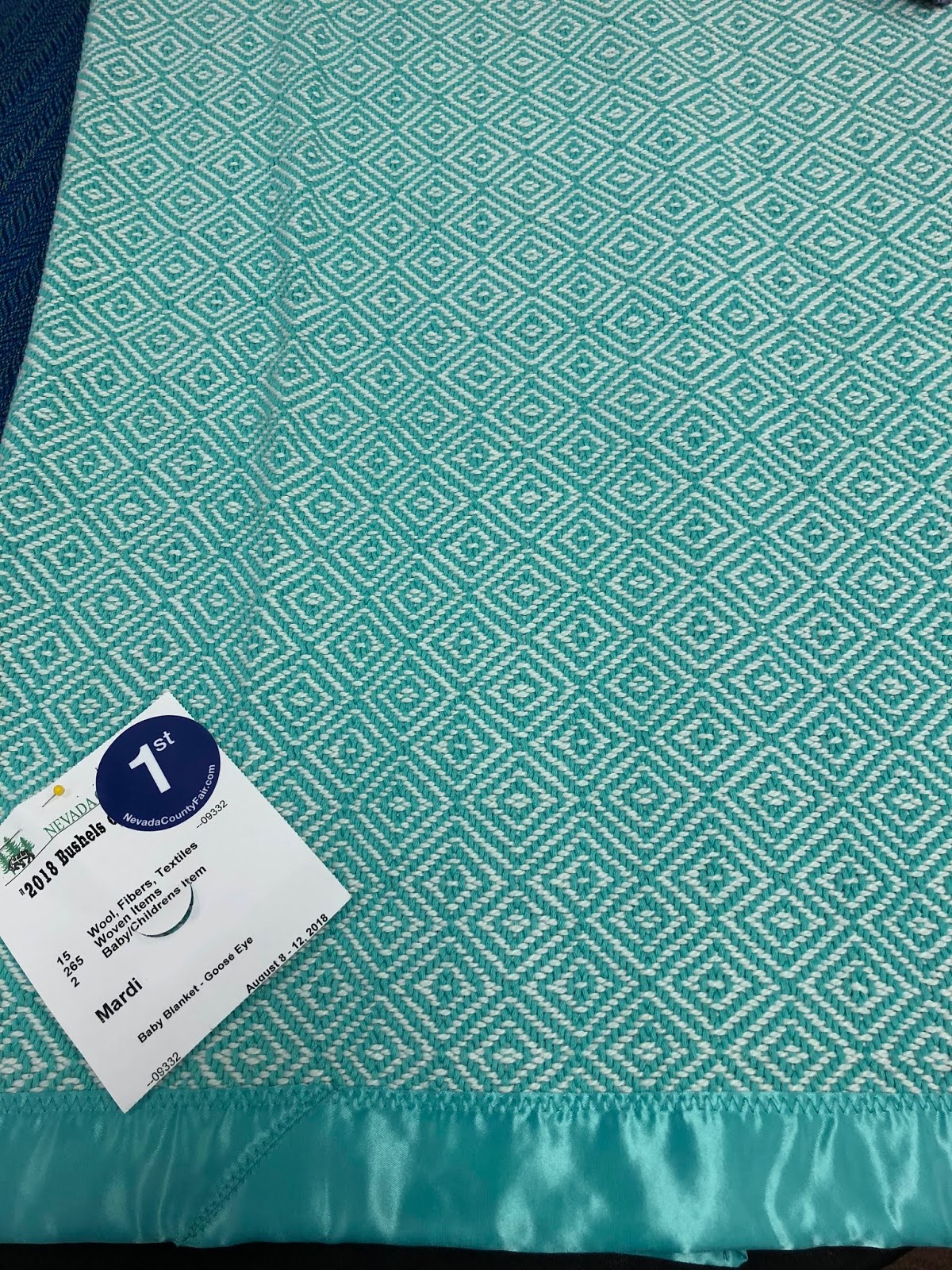
Mardi entered several items starting with a beautiful baby blanket, using a gradient color scheme.


Mardi's Baby Blanket


She entered two sets of napkins - one also with a gradient color scheme.

Mardi's Napkins
Mardi's Napkins


This turned twill scarf on the left was woven with a cotton warp and a silk weft.  The pink scarf was woven with linen.


Mardi's Turned Twill Scarf

Mardi's Linen Scarf


________

Mardi also entered two tea towels.

Mardi's Towel

Mardi's Towel

Karen entered a rug that she wove using shaft switching technique.

Karen's Rug

Jeanne entered a poncho that was woven using Robin Lynde's V-Shawl technique.  It's a doubleweave shawl with a V-shaped back.  

Jeanne's Poncho


She entered two sets of placemats.


Jeanne's Placemats

Jeanne's Placemats


Jeanne also entered a towel.


Jeanne's Towel

Jeanne's final entry was a Ganges Linen Scarf

Jeanne's scarf

There are more entries that will be posted soon.  

Wednesday, October 23, 2019

Twill Exploration

Observations about weaving twill towels from Mardi:

After completing some relatively difficult projects and wrestling with adding  4 shafts, expanding my Ideal Glimakra loom to 8 shafts, I decided to try a set of “easy” twill towels.  I browsed through 8-Shaft Patterns , edited by Carol Strickler and noticed that there were several variations of twills threaded in an 8 shaft straight draw and decided to explore the possibilities.  

First I decided on color and design and got started.  I chose turquoise with green stripes, sett at 18 EPI. The width in the reed was 22inches.  I wove the towels to 33 inches plus allowance for hems. 

Plain Weave is always a good place for me to start, just to see what the overall color effect is.  The result was as expected.  Then I tried #2, #13, 327 and #29.  I discovered that not every pattern looks good on both sides.  I also discovered that I hadn’t checked for floats.  There were a few with 4 thread floats. I wasn’t sure that was going to be acceptable. When I took the towels off the loom I wasn’t happy at all and then remembered that it is really not possible to evaluate the results without wet finishing.  They actually turned out satisfactorily.
Turquoise Towel

Another Turquoise Towel


After finishing the turquoise towels, I wanted to see if it would be possible to tie on a second set.  One might think that is easy, but I had not tied the first warp onto the back beam. I had looped a rod through to attach the warp.  I didn’t know how to tie on to slipping threads.  It was suggested at a meeting (Thank you Jackie Hervey) that I try to stabilize the first warp by weaving a short section in front of the reed, allowing enough thread length to complete the tying process. It worked beautifully and a second set of yellow striped towels was secured. Due to the difference in yarn grist, I decided to re-sley to 20 EPI.

Yellow Towels with Tied-on Warp

I decided to try #21, Brighton Honeycomb for the first towel.  It gave a nice texture (with some really long floats).  The finish was satisfactory.  Doubting further experimentation, I wove off the 3 remaining towels in plain twill and was really quite pleased.

My final notes to self are as follows.  First, I should sample.  I should also use Fiberworks to check things like floats and back of fabric view.  I also decided that while a straight draw “looks easy”, the patterns that can be achieved are somewhat limiting.

Monday, August 26, 2019

Highlights from the County Fair

The Local County Fair has come and gone.  The weaving and spinning entries were amazing as usual.  Many of the Not 2 Square members entered beautiful pieces again this year.  Here are the highlights.

Betsy captured the People's Choice award with a beautiful shawl made from hand-dyed tencel.

Betsy's Shawl


Diana garnered an Honorable Mention with her bright and fun turned taquete towels made with 10/2 and 8/2 cotton.  


Diana's Towel

Ingrid submitted a shawl woven from Madeline Tosh merino yarns.  This was woven in an 8-shaft extended twill pattern.

Ingrid's Shawl


Jeanne won a second place ribbon with this elegant hand towel.  She wove it with 40/2 Normandy linen with Lanis Valley Linen as the pattern.

Jeanne's Towel


Karen won a first place ribbon with a fabulous wool rug.  

Karen's Rug

Marcy's classic dresser scarf, woven in cotton with M's and W's pattern won a second place ribbon.

Marcy's Table Runner

Mardi's show stopping shawl was woven in plain weave with rayon chenille.  It feels as fabulous as it looks.


Mardi's Shawl


Sue R. woven a colorful table runner from the warp left over from last year's demonstration project.  She used bleach to remove color from black yarn for the weft.  This inventive piece was a first place finisher.


Sue R's Table Runner


Sue V.'s yardage entry brought her a second place ribbon.  This cotton piece woven in a twill design used a variety of yarns from Sue's stash.

Sue V's Yardage

We are starting to look ahead to what we will be weaving for next year's fair entries.

Tuesday, February 12, 2019

Reflections on my Plainweave Boucle Towels by Mardi Naythons

The inspiration for these towels came from an item in Jane Stafford’s studio, using similar colors.  From there, I decided to work on gradation, using Fibonacci sequences and division of space. 

 
The warp was made up of Boucle cotton and 5/2 cotton, which I wound together so that most of the time the boucle threads weren’t adjacent.  I also tried to use gradation in changing colors.


As I wove, I changed the weft colors as I went.  I had a basic plan, but I let the colors be my muse.  There were a few surprises along the way, for example, I had never considered using white in the weft, but it worked well.  Also, at the end of the warp, I decided to just use straight orange rather than putting in stripes.  It turned out that there was enough to make a towel, though it was slightly shorter than the others and I really liked it.


Wednesday, August 15, 2018

County Fair Part 2

The next two members' entries we would like to highlight are from Mardi and Marcy.

Mardi entered a baby blanket, napkins, table runner, a shawl, two towels and a caplet knit using hand-spun yarn.

Mardi Baby blanket

Mardi Caplet knitted with hand-spun

Mardi Napkins
Mardi Table runner

Mardi Shawl

Mardi Towel
Mardi Towel


Marcy also entered two items: a scarf and a towel.

Marcy Scarf

Marcy's towel


There will be more members entries later. 

Thursday, December 14, 2017

A Design Process Story

Mardi showed some beautiful scarves at the last meeting.  She shares her process in the narrative below.
 
 
The Process:

First I wanted to make a scarf using some knitting yarn left from an abandoned knitting project and used Cascade Sock yarn as the weft. The draft was something that I put together by taking some of the twill threading I liked from another project.  Unfortunately, the weft yarn ran out before planned and the scarf is a little shorter than planned, but still acceptable.  I decided to experiment with the remaining warp.

#1 - I used some homespun singles from some gray CVM that I had spun.  It compressed the twill but it was a little scratchy. (Igor liked that one.)
 
#2 - I used some alpaca knitting yarn that I had around, similar color but it had a larger grist.  It was very satisfactory in terms of softness.
 
#3 - I wanted to see what would happen if I used a color in the weft.  I didn't have anything that matched the magenta in the warp, but I had some wine colored yarn sitting on a bobbin and decided to use it.  The result was softer than the other 2 samples and I liked the color the best.  I might add that I never liked the warp yarn very much, so almost anything improved it.