Showing posts with label rug weaving. Show all posts

Sunday, April 24, 2011

It's All About Chenille

There is chenille and then again there is chenille.  Sue Robertson was shopping through magazines for weaving project ideas and kept coming upon articles that showed you how to weave chenille yarns for another project. It almost seemed like a "sign" that she should undertake this task. She and her mother are both quilters - so there were abundant fabric scraps and Sue had this and that leftovers of acrylic yarns.  So the first step was to cut everything into strips and put on a widely spaced warp.  Sue said the threading for the warp wasn't a straight draw, but she didn't have her original draft, so we will have to guess what it was.  The weaving is straight forward and the results are in the photo below.  

This photo is a good one to enlarge to look at the details of the weft in this rather solid and weighty piece.

The next step is to cut lengthwise  between the warps with a rotary cutter and voila, you have chenille yarns.


The last step will be to weave this handwoven chenille into a rug.  Twice woven and twice the fun.

Because I was interested in finding articles about this process, I went through my stash of Handwoven, Weaver's and Praire Wool Companion magazines.  I'll bet the directions can be found in Spindle, Shuttle and Dyepot, but I didn't get those out to look.  Here is a little bibliography for those of you who may find yourself with stash that is too good to throw away, but not good enough to weave with. Turn it into chenille!

Beck, Ulrike. "A Pile Rug in Handwoven Chenille". Handwoven. Jan/Feb. 2008: pp 36-39.
Gaustad, Stephenie. "Do-It-Yourself Chenille". Handwoven. Sept./Oct. 1992: pp.62-64.
Piroch, Sigrid. "A Plushy Mat for a Cat". Handwoven. Sept./Oct. 1996: pp. 53-55.
Xenakis, David. "Yarn for the Weaving". Prairie Wool Companion. Issue 7: p21.

While we are on the subject of chenille, Gus Young showed us her masterpiece in progress.  She had two different weights of white rayon chenille yarn.  After winding warp chains alternating both yarns, she soaked them in soda ash and painted them with fiber reactive dyes.  The darkest threads are teal - then she just kept added more water to get a lighter and lighter color.  This is the backbone of a chenille shawl - weft will be teal rayon and cotton.  The loom is a Gilmore (of course)!

An interesting feature of this photo is the way Gus has tied bouts of her warp to the back beam using texolve heddles.  She loops texolve around a dowel tied to the back beam and then knots bouts of her chenille and forms a larks head  around that knot to secure it to the back beam. 

During the meeting we talked about fringes on a chenille piece.  Most people twist them first before washing.  We are always on the lookout for good ideas, so if you (reader) have any good tips, please add them to our comment section. 

Sunday, April 25, 2010

Snow Day continued

A few meetings ago, Jackie gave some handwoven yardage to Marcy.  Marcy made pillows that enhanced her living room decor and brought one as a present for Jackie.  The dark blue sofa at Ingrid's
home  overwhelms the subtle colors from the pillow and  I should have looked for a more neutral backdrop to take the picture.  But having seen Marcy's living room colors, the pillows will be very much at home there. 

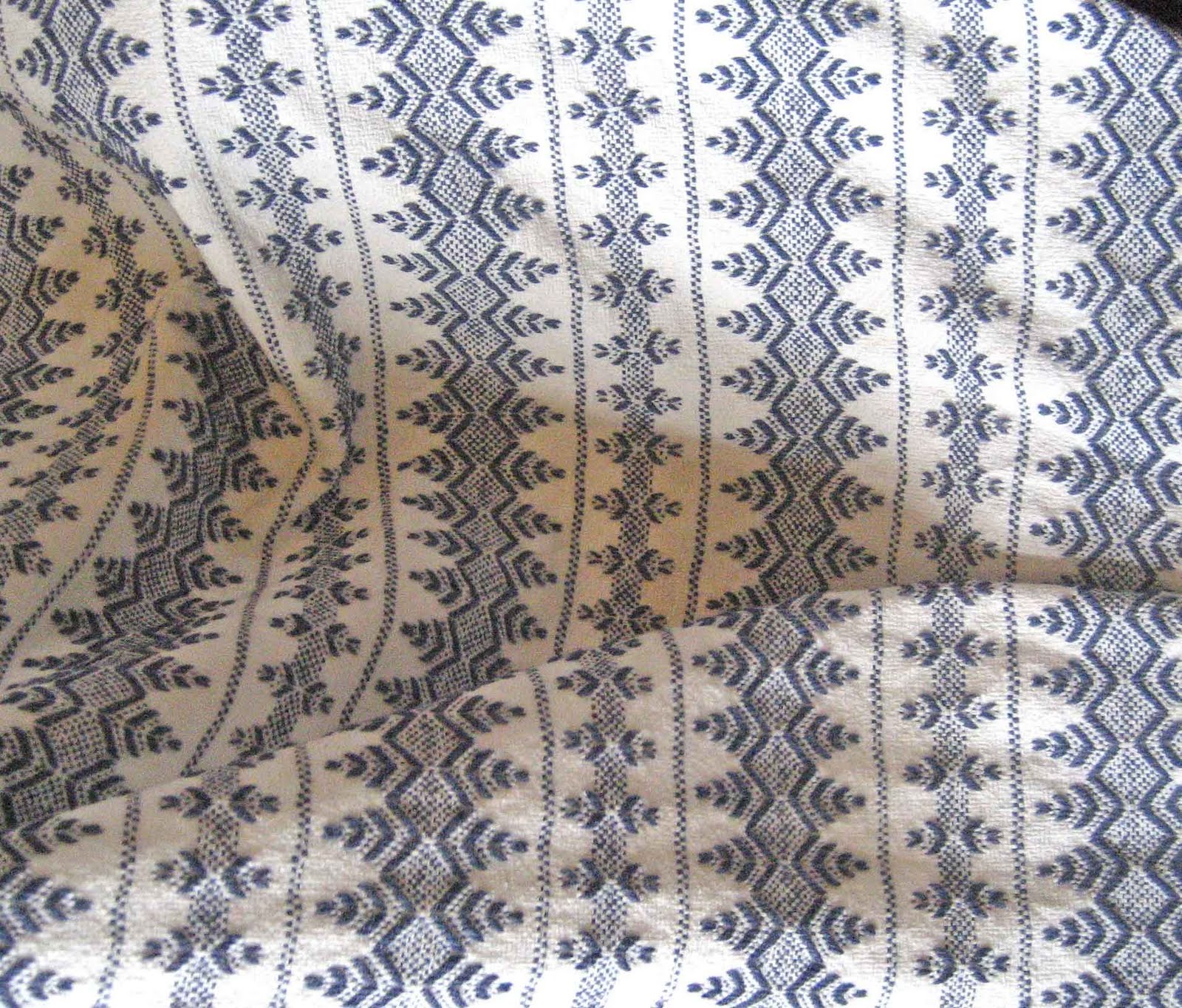
Marcy's husband frequents estate sales looking for old books.  He found this throw at a sale and purchased it because it was so intriguing.  After examining it, we decided it is huck embroidery done on what may have been handwoven cloth. The structure of the underlying cloth is used in a manner similar to counted cross stitch to embroider a design. It is quite a large piece and must have taken a long time to embroider.


Sue H. brought some examples of her wall hangings and rugs.  This striking piece is called wedge weave and was woven in a tapestry technique done by Navajo weavers. One of the features of this kind of weave is a wavy edge. Sue has left the working threads loose on this piece. She told us that the weaving starts at one corner and then progresses from there. 

The photo below is part of a rug sampler piece Sue wove using techniques in Peter Collingwood's rug book.  What a good idea to do a practice piece before you tackle an entire rug.