Showing posts with label wendy-marie teichert. Show all posts

Monday, December 29, 2025

Turned Twill with a Color Twist


The Not 2 Square Weavers have been meeting through the magic of Zoom for several years.  This really bites into our ability to handle all the lovely textiles that members have woven, but  we still have the pleasure of looking at the colors and hearing the stories of how they have been created.

This past month, Karen W. talked to us about her adventures with a color trick on a turned twill design that she she wove.  She was eager to use up bits and pieces of yarns from her stash and fished out four colors she thought might work with a draft that another member (Wendy-Marie) had shared with the group. 

 
 There are lots of ways to give this color trick a whole new look.  Wendy-Marie used 8 colors in her towel (see photo below).


 And really pushing the envelope, there are 14 different colors in this towel.  The optical illusion  is that this towel has been turned on its side in case you were wondering how the colors rearranged themselves!


 Just so you can get a really good look at what is happening, here is a close up photo.

This is such a neat trick to make a design look very complex and we wanted to share it with all of you. What a fun way to use up stash odds and ends and get a lot of bang for your buck! 


 The draft, shown above, isn't a complete repeat of the design, but the trick is in overlapping colors in both the warp and the weft.  As you can see from the draft above, you don't keep the colors strictly within the blocks.  The little color trick allows you to get more visual blocks in your design.  Karen kept her color sequence in the warp and the weft the same, so that her overall design was symmetrical.  This  is one choice.  You could do a free form design, but warping stripes of various colors in no particular width, then weaving in a similar fashion by either using the same colors as are in the warp, or different colors.  Hint:  Click on the draft photo for a larger  view of the details.

The source for this draft is Handwoven Nov/Dec 2013 pp.38-39 by Yoriko Oki with Vicki Robinson.  Their article shows the draft with separate instructions for the color placement.  With these instructions you can weave the pattern and their article indicates the resource they used was a great article by Alice Schlein in an older Handwoven issue (Mar/Apr 2001). Alice's article starts on page 38 and has a clear draft with the color placement on the draft itself, making the process much clearer to me.  Once you have the concept in mind, you can alter color placement to make many more interesting twill plaid designs.

Another way you might tweek your draft would be to vary your tie up.  Look at this article for ideas https://bannermountaintextiles.blogspot.com/2024/02/two-block-twills-with-multiple-tie-up.html 


Sunday, August 27, 2023

A Challenge for 2023 Part 2

You don't need a challenge for a weaver to want to "shake things up".  What follows are interpretations of the same threading draft and the weaver's comments about their take on the challenge. As expected, no two experiments are the same.

I've taken some of the text posted on the display board from the fair and added a few thoughts of my own.

The Basics of Weaving
The patterns for weaving come from three components: the threading, tie-up and treadling.  Any combination of those three items will affect the outcome of the woven item.  In each example, the threading was kept the same or enlarged for the project, but the tie up and sometimes the treadling was changed.  In the five works, see if you can pick out what is the same and what is different. 

Mardi Naythons
Since this was the first time that I worked with advancing and point twill together, I decided to use the original threading as noted.  It is a smaller sample because of that.  It has only 396 threads.  The treadling is tromp-as-writ.  The one thing that I did do to make it somewhat mine was to make an ice dyed warp in sections.  I tried to make the outer areas the same and I jogged the
middle section in the dye bath so that it would be different.

Ingrid Knox
I took the original threading and extended it to the width I needed for a towel.  I created two different random stripe patterns for the two areas with different threading designs.  The tie-up is a 1-1-1-1-2-2 pattern.  This towel used a tromp-as-writ treadling – that means I used treadles that mirrored the threading.  The towel was woven using 10/2 cotton for the warp and weft.  The sett is 30 epi.


Jeanne Doty
There were so many weaving possibilities in this weaving draft.  Beryl Moody provided us with 37 different tie ups.  Since it was difficult to choose just one, I chose 5 and made a scarf instead of 5 towels.  It was fun to see these different drafts right next to each other.  The warp was maroon 8/2 tencel with a lemon green 8/2 tencel weft.  Each draft made changes to the color play, some bringing the warp color forward while another draft would bring the weft color forward.


Wendy-Marie Teichert
What was fun about this project was seeing how much variety could be achieved simply by changing the tie-up. I experimented with different weft colors – light purple, light yellow, blue and rose – to contrast with the dark purple warp. In retrospect, I think the weavings would have been more successful if I’d kept the weft color constant and varied the warp colors instead.

Beryl Moody
Weavers are always looking for a way to express their own ideas in the items they choose to weave.  This weaving draft was ripe for an adventure.  Having woven it nineteen years ago in a rather straightforward manner, I was thinking about what changes I could make this time around.  

I decided that if I were to alternate colors in certain sections of the warp and then weave that warp with alternating colors this could change the appearance of the final textile, yet have it retain some of the original design.  This method (in weaver's vernacular) is called color-and-weave. Where there are alternating color changes they tend to obscure the original design and give you something with an entirely new look.  The towel I wove is a combination of the original draft showing through, along with sections of color interplay that distort that original pattern. 


Here is a photo of one of the original towels woven 19 years ago.  It is tromp-as-writ and resembles a ripe banana - thus the addition of the fruit!


Thursday, September 30, 2021

Blooming Towels from Wendy-Marie's Loom

"These charming Texas Bluebonnet towels, designed by Cheryl Leib, appear in the Mar/April 2019 edition of Handwoven. They are very sturdy and make excellent gifts. The yarn is 8/2 unmercerized cotton, sett is 24 epi. Leib recommends that the plain weave hem be done with sewing thread or 20/2 cotton. This is important to keep the PW hem even with the twill cloth. (Ask me how I know.)

The first time I made these cloths, I used the blue yarn available in my stash. This round, I ordered the recommended blue, Brassard Medium Blue #5029. It is a beautiful, vibrant color. For my next batch I will  order more instead of making substitutions. "  Wendy-Marie 


Saturday, May 22, 2021

From Not 2 Square Looms

  Weaver's are always on the lookout for new ideas, new structures, new ways to use color and texture in their projects.  Here are a few relatively recent projects by our members.

_______________________________________________________________________________

 From Wendy-Marie's Loom

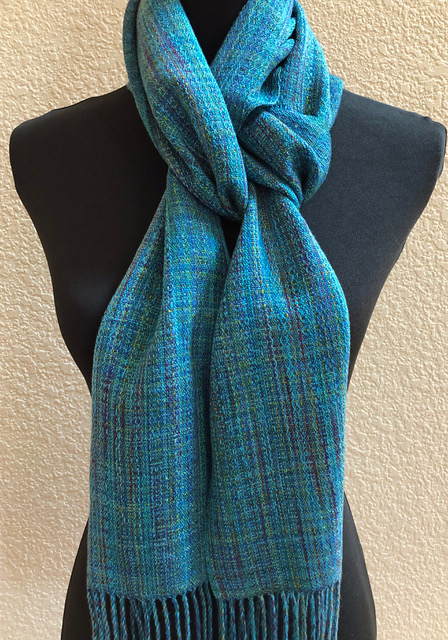
These scarves are part of on-going play with the patterns offered in Denise Kovnat's "Echo and Jin" workshop. The teal scarf is an 8-shaft pattern called "Chakras." The warp is tencel and 10/2 perle cotton, the weft is 20/2 perle cotton, sapphire. The sett is 40 epi. Denise strongly recommended that we avoid white, as it tends to cancel out the other colors. I think the silver tencel in this scarf had the same tendency, so the scarf is interesting but not iridescent as I had hoped.


The second pair of scarves are made using a 4-shaft Kovnat pattern called "Blooming Leaf." Again, the sett was 40 epi. The left hand one had a purple 10/2 cotton for weft, the right was made with fuchsia 20/2 perle cotton. Of the two, the fuchsia weft produced a lot more iridescence. 


_________________________________________________________________________________

Ingrid's Projects

Several Not 2 Square members are working on our local fiber guild's challenge.  We were given three colors and were challenged to create a fiber project using those colors. I got forest green, navy and turquoise and wove towels using those colors with some others.  They were made using 10/2 cotton for the warp and weft.  The structure was a regular/irregular point twill on 8 shafts. I  was also participating in another guild's challenge: weave something with colors inspired by a national park poster and this project satisfied both challenges.


 I also finished the linen towels I wove as part of another guild’s challenge.  16/2 linen for warp and weft for most of the towels, although 2 were even with 10/2 cotton.  The design is an 8-shaft huck.

_________________________________________________________________

Betsy's Current Project

Betsy is weaving a lap blanket for someone who needs a bit of warmth while she is in church.   She is using the intended recipient's favorite colors - teal and magenta in warm wools. The structure is an M & W twill. After this blanket is completed, she intends to use an orange weft on the next one. 


__________________________________________________________________________________

Eileen's Adventure in Wet Finishing

 I don't remember where I found this draft, possibly online.

 
The yarn is from Webs - Colrain Lace - 2/10 Merino?Tencel.  The floats were too long, particularly on the back side.

 
On the Loom 


I normally wash my woven products in the washing machine on the gentle cycle and cold water.  Well, in this case, the yarn felted a great deal and was perfect as the floats felted together and are not now problematic.

Subsequently, I always wash all products with this yarn by hand.

 
Off the loom and after wet finishing


Saturday, March 20, 2021

The March Meeting and Its Weaving Surprises


Karen W. wove this stunning black and white rug using shaft switching techniques.  She devised the pattern by graphing it on paper first.  Then she employed the shaft switching system she devised for her 4 shaft Gilmore loom.  (see photo at left)

The warp is 8/5 linen sett at 4 epi.  The weft is Collingwood rug yarn using three strands together.  The finished rug is 25" x 40".


--------------------------------------------------------------------------------------------------------------------------


Wendy-Marie wove this gorgeous "Spring Flowers Shawl".  The draft and directions were from Handwoven's Design Collection #19.  The advancing twill design is by Hele Bobisud.  Since the original pattern called for a weaving width of 26", Wendy-Marie removed two blocks of burgundy (84 ends) from the warp so that it would fit on her Baby Wolf loom.  The final shawl size is 85"x 20".  Another change that she made was to substitute 8/2 tencel for the Zephyr wool-silk given in the instructions.  The shawl feels soft and drapes nicely, so the substitution worked.

The photo below shows the draft used for the shawl.

----------------------------------------------------------------------------------------------------------------------------


Both this scarf and the one below were woven by Ingrid K. out of JOY 10/2 tencel in both the warp and weft.  The sett is 36epi.  The draft used on the scarf at the left is an extended point twill.  The photo below was threaded on left M's.  Both were woven on an 8 shaft loom and treadled with an advancing point.


The lap robe was also woven by Ingrid in wool/acrylic (50/50) knitting yarn sett at 12 epi.  The structure is an extended point twill with a point treadling on 8 shafts.

Monday, June 22, 2020

Pandemic Weaving

Not 2 Square Weavers have been meeting monthly for many years.  All of a sudden, the pandemic put all of that to an end, at least for the foreseeable future.  So, like many other groups, we have reverted to Zoom meetings.  

The first few meetings were a bit strange because we are used to passing around our month's work, asking questions and feeling the textiles with our hands. But, after several meetings now, we are getting used to the new format and still want to share what we are doing with other weavers.

This month, Diana shared a stunning scarf with us.  She delved into the world of supplementary warp and used a pattern from an older issue of Handwoven. 

Here is her description and a photo of that scarf.

Structure
Ground Warp- plain weave and Atwater-Bronson lace
Supplementary Warp - Overshot

Fiber
Ground warp:  8/2 rayon in pale yellow and natural
Supplementary warp:  20/2 rayon doubled, in teal
Weft:  8/2 rayon in pale yellow

Sett
24epi (48epi in supplementary warp areas)

Finished size
8 1/4" W x 73"L + fringe

Notes
When winding the warp, add at least 20% more in length to the supplementary warp than you have wound for the ground warp.


________________________________________________________________________________

Ingrid has been weaving scarves, and like Diana, is trying out new weaving ideas.

Here’s a picture of the new scarf.  It was woven with 10/2 tencel from Just Our Yarns (different color-ways for the warp and weft), sett at 36 epi.  The structure is an 8-point M’s twill, the tie-up is 2-2-1-1-1-1- twill.  It wove up beautifully, didn’t shrink much and felt nice and soft after a gentle machine wash and laying flat to dry.

_________________________________________________________________________________
Wendy-Marie has moved out of the area, but the fun thing about Zoom is that she can again participate in Not 2 Square.  This month she had a couple of adventures to share.

"This month I worked on a scarf based on Sarah Jackson's "Brasberry Scarf," (Handwoven, May/June 2019).  Since she used analogous colors and I did not, I was not sure how it would turn out.  But the blocks came out fine.  In the Jackson pattern, the weft changes color 4 times, and the blocks expand as the scarf progresses.  I think I will re-do using only one weft color and only one block size.

My second project was a boundweave rug based on Wendy Bestor's design, but not her colors.  This uses Collingwood rug wool (900 ypp).  I found it came out better for the weft if I wound three threads of wool together on the bobbin than to throw the yarn three times in one shed as suggested by the pattern.  I did not achieve anything like 14 ppi, so ran out of warp.  My weaving buddies tell me this is because I was using my Baby Wolf and suggest that I weight the beater next time round.  Despite a number of weaving errors (including accidental asymmetry), I like this rug a lot.  It is very attractive and sturdy."


Saturday, May 30, 2020

Circles and Rectangles

My offering this month is based on Susan Poague’s “Circles and Checks Towels in Turned Taqueté” in the May/June 2019 issue of Handwoven. I used the yarns I had in my stash rather than those she suggested, but I did alternate blues and green as she does, with a neutral Birch color substituted for her Natural. The yarn is 8/2 unmercerized cotton, sett is  24 ppi. - Wendy-Marie T.


Monday, August 13, 2018

If it's August, it Must be Time for the County Fair

The second week in August is a busy time here in Nevada County.  The local fiber guild is responsible for setting up and managing the woven, spun, felted and handspun made entries.  Members of Not 2 Square did their part and entered their fiber exhibits.  Wendy-Marie entered two scarves and a shawl.  

The top scarf was woven and then enhanced with fabric paint and a stencil to create the leaf pattern.


Wendy-Marie's shawl was designed using a musical score and assigning colors and widths of stripes based on the music.

Sue V entered a number of items.  There were two sets of napkins (top pictures) and two towels (bottom pictures).


Her Nevada County Inspiration piece was designed with local river salmon in mind.

Sue also wove a scarf using the "snake skin" pattern featured in Handwoven magazine.  


This is just the beginning of the entries.  More to come in later posts.

Monday, August 28, 2017

Fair and Square - continued


Wendy-Marie offered a rep weave table runner, using Rosalie Neilson’s pattern in the the May/June 2017 issue of Handwoven. The warp is 3/2 cotton sett at 30 epi. The weft alternates 3/2 cotton for the thin pick with 8/16 mop yarn tripled for the thick pick. The runner is finished with four rows of Cavandoli knots. Having studied Rosalie’s DVD course on rep weave, she believes the draft in Handwoven has some errors –that shaft 4 should be paired with shaft 8, and shaft 3 should always pair with shaft 7. 


 She also made matching placemats.


The same issue of Handwoven had a design by Deanna Deeds called “Gumdrop Scarf.”  Wendy-Marie used this pattern to produce her Nevada County Inspired entry, a “Farmer’s Market Scarf.” The warp is tencel, sett at 24 epi at the two ends, and changed to 16 epi for the body of the scarf using Beryl and Igor’s variable reed. The reed is 12 epi, but the top comes off so that the weaver can rearrange the warp. This reed allowed for a more even distribution of the warp once the edging was completed. The scarf is finished with Danish Medallions. Diverging a bit from the pattern, Wendy-Marie used bambu for the weft, which helped make the scarf softer and drapier.


 Her dishcloths are based on the “Herringbone Twill Towels” by Linda Gettmann, from the Sept/Oct 2014 issue of Handwoven. Where would we be without that magazine? Yarn is mostly 8/2 cotton, with a smattering of tencel and 5/2 cotton used for color. The sett is 20 epi.