Monday, December 29, 2025

Turned Twill with a Color Twist


The Not 2 Square Weavers have been meeting through the magic of Zoom for several years.  This really bites into our ability to handle all the lovely textiles that members have woven, but  we still have the pleasure of looking at the colors and hearing the stories of how they have been created.

This past month, Karen W. talked to us about her adventures with a color trick on a turned twill design that she she wove.  She was eager to use up bits and pieces of yarns from her stash and fished out four colors she thought might work with a draft that another member (Wendy-Marie) had shared with the group. 

 
 There are lots of ways to give this color trick a whole new look.  Wendy-Marie used 8 colors in her towel (see photo below).


 And really pushing the envelope, there are 14 different colors in this towel.  The optical illusion  is that this towel has been turned on its side in case you were wondering how the colors rearranged themselves!


 Just so you can get a really good look at what is happening, here is a close up photo.

This is such a neat trick to make a design look very complex and we wanted to share it with all of you. What a fun way to use up stash odds and ends and get a lot of bang for your buck! 


 The draft, shown above, isn't a complete repeat of the design, but the trick is in overlapping colors in both the warp and the weft.  As you can see from the draft above, you don't keep the colors strictly within the blocks.  The little color trick allows you to get more visual blocks in your design.  Karen kept her color sequence in the warp and the weft the same, so that her overall design was symmetrical.  This  is one choice.  You could do a free form design, but warping stripes of various colors in no particular width, then weaving in a similar fashion by either using the same colors as are in the warp, or different colors.  Hint:  Click on the draft photo for a larger  view of the details.

The source for this draft is Handwoven Nov/Dec 2013 pp.38-39 by Yoriko Oki with Vicki Robinson.  Their article shows the draft with separate instructions for the color placement.  With these instructions you can weave the pattern and their article indicates the resource they used was a great article by Alice Schlein in an older Handwoven issue (Mar/Apr 2001). Alice's article starts on page 38 and has a clear draft with the color placement on the draft itself, making the process much clearer to me.  Once you have the concept in mind, you can alter color placement to make many more interesting twill plaid designs.

Another way you might tweek your draft would be to vary your tie up.  Look at this article for ideas https://bannermountaintextiles.blogspot.com/2024/02/two-block-twills-with-multiple-tie-up.html 


Sunday, December 07, 2025

Remembrance of Not 2 Square Members and Mentors


 I searched long and hard to find the photo of these three weavers who were part of Not 2 Square at its beginning.  It was taken at a gathering of Foothill Fibers Guild at the home of Sue F.  Actual date, unknown.

Left - Barbara Woodward (obituary)

Middle - Dee Jones (obituary) (our memorial post)

Right - Carol Phillips  (our memorial post)

All are now gone, but certainly not forgotten. May this post help to keep them in our memories.


Thursday, October 17, 2024

More from the County Fair 2024

 Mardi entered several items in this year’s fair.   

The wool scarf was woven with her hand spun yarn. She wove it on a rigid heddle loom for a demonstration, just to see if it would work out.  She decided to finish and enter it.


The overshot scarf was woven with a natural 8/2 cotton and the wefts were a chocolate-colored Zephyr and an autumn orange 20/2 silk.


The green and white scarf, an entry in the county inspired division, was inspired by our native dogwood trees.  The draft was by Rebecca Logan - number 79333 on Handweaving.net.  It was woven with 8/2 Tencel white, and variegated greens from Webs.


 The towel structure is halvdrall, woven with 8/2 cotton.


The Tablet weaving band was her first attempt.  She decided to make bookmarks out of band.


Karen entered some color and weave cotton towels and a band - all in black and white.


Tuesday, September 17, 2024

County Fair 2024

The County Fair has come and gone with lots of activity from the local fiber artists including Not  Square members. We will give you a glimpse of what our members entered this year.


Mary wove these California Quail towels for the fair.

She says, "The desire to weave cute quail led me down the path of understanding and drafting single two-tie unit weave. It also led me to a 32-shaft compudobby loom! This quail towel was woven with a 10/2 unwaxed cotton warp, 8/2 unmercerized pattern weft and 20/2 cotton ground weft. The sett was 20 end per inch which provides a nice hand in the “summer and winter” structure."


Ingrid & Mary entered a collaborative project - a scarf woven by Ingrid with Mary's handspun merino yarn.  The sett was 15 epi.  For the warp, Ingrid used a 20/2 tussah silk yarn.

Mary & Ingrid's Collaborative Scarf

Ingrid entered several other woven items into the fair this year.  She entered two twill towels woven with 10/2 cotton set at 30 epi on 8 shafts.

Ingrid's Twill Towel


There was a lap robe woven with cotton for the warp and an acrylic/wool blend for the weft in plain weave.  And a plain weave baby blanket with cotton for warp and acrylic for the weft as well.

Ingrid's Lap Robe
Ingrid's Baby Blanket


She entered three scarves other than the collaboration project.  One was woven in plain weave with merino/silk yarn in the warp and a silk weft.  

Ingrid's Silk/Wool Scarf

The second scarf was 8/2 Tencel for the warp and weft that she dyed.  It was sett at 30 epi and the structure was an extended twill.  The inspiration for the color scheme and scarf structure was the Yuba River.

The third scarf was woven using 10/2 Tencel sett at 36 epi.  The structure was an extended point twill woven on 8 shafts.  The weft was also 10/2 Tencel.

Ingrid's Tencel River Inspired Scarf

Ingrid's Tencel Scarf
We'll continue this on a later post.

Saturday, September 16, 2023

More from the County Fair Part 2


 Ingrid wove these two scarves that are intertwined around one another using a technique called gradients.  A couple (or several) colors are gradually changed from one being dominant to being the subdominant color.  These were techniques she learned in an online class and expanded into her own designs.

 The color changes in the scarf below (also woven by Ingrid) move from dark to lighter and the effect when tied around the neck is stunning in its complexity.   It is 10/2 Tencel, sett at 36 epi and woven with an extended point twill on 8 shafts.


This is a shawl that Ingrid entered in the fair this year.  She wove it with Malabrigo Silkpaca lace yarn for both the warp and the weft.  The structure is twill.

More from the 2023 Nevada County Fair - Part 1


 This is Ingrid K. gorgeous scarf.  Woven in double weave, this scarf won the best of show for the Handwoven category.  Truly stupendous color work and design.  Congratulations, Ingrid.


Ingrid collaborated with Jeanne when weaving this scarf.  Jeanne spun the weft yarn and Ingrid used it on a wool warp.  Enlarge photo to see the details.


 The photo to the right is a close up of a scarf woven by Jeanne D.  Her description follows in italics.

Simple Collapse Weave Pucker up Scarf
The puckers in this scarf are created by using Merino wool and Bombyx Silk. This was
a kit that I purchased from Jane Stafford Textiles. It was woven on a 4 shaft loom with
a sett of 15. The warp alternated sections of 18/2 merino wool and 30/2 Bombyx Silk in
two colorways. The weft used the same yarns creating squares. The magic happens
when the scarf is felted. The wool shrinks and the silk does not created the puckers in
the scarf.


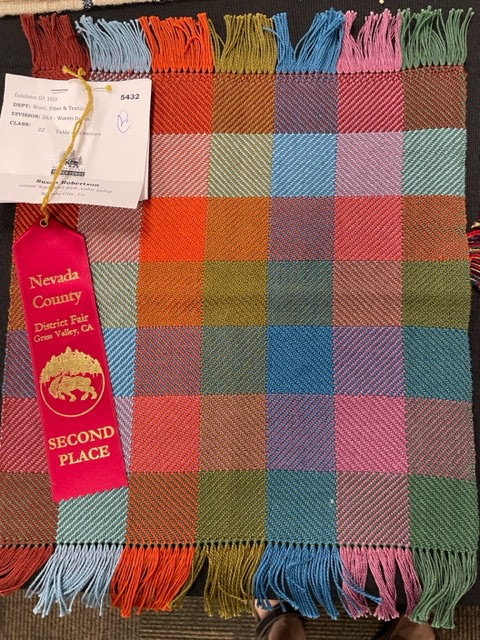
Sue R. won a second place on this lovely place mat woven with twill blocks.  Great colors too!

These towels were also woven by Sue. R.  Great designs and a lovely little diamond pattern.  Both woven on a four shaft loom.


Sunday, August 27, 2023

A Challenge for 2023 Part 2

You don't need a challenge for a weaver to want to "shake things up".  What follows are interpretations of the same threading draft and the weaver's comments about their take on the challenge. As expected, no two experiments are the same.

I've taken some of the text posted on the display board from the fair and added a few thoughts of my own.

The Basics of Weaving
The patterns for weaving come from three components: the threading, tie-up and treadling.  Any combination of those three items will affect the outcome of the woven item.  In each example, the threading was kept the same or enlarged for the project, but the tie up and sometimes the treadling was changed.  In the five works, see if you can pick out what is the same and what is different. 

Mardi Naythons
Since this was the first time that I worked with advancing and point twill together, I decided to use the original threading as noted.  It is a smaller sample because of that.  It has only 396 threads.  The treadling is tromp-as-writ.  The one thing that I did do to make it somewhat mine was to make an ice dyed warp in sections.  I tried to make the outer areas the same and I jogged the
middle section in the dye bath so that it would be different.

Ingrid Knox
I took the original threading and extended it to the width I needed for a towel.  I created two different random stripe patterns for the two areas with different threading designs.  The tie-up is a 1-1-1-1-2-2 pattern.  This towel used a tromp-as-writ treadling – that means I used treadles that mirrored the threading.  The towel was woven using 10/2 cotton for the warp and weft.  The sett is 30 epi.


Jeanne Doty
There were so many weaving possibilities in this weaving draft.  Beryl Moody provided us with 37 different tie ups.  Since it was difficult to choose just one, I chose 5 and made a scarf instead of 5 towels.  It was fun to see these different drafts right next to each other.  The warp was maroon 8/2 tencel with a lemon green 8/2 tencel weft.  Each draft made changes to the color play, some bringing the warp color forward while another draft would bring the weft color forward.


Wendy-Marie Teichert
What was fun about this project was seeing how much variety could be achieved simply by changing the tie-up. I experimented with different weft colors – light purple, light yellow, blue and rose – to contrast with the dark purple warp. In retrospect, I think the weavings would have been more successful if I’d kept the weft color constant and varied the warp colors instead.

Beryl Moody
Weavers are always looking for a way to express their own ideas in the items they choose to weave.  This weaving draft was ripe for an adventure.  Having woven it nineteen years ago in a rather straightforward manner, I was thinking about what changes I could make this time around.  

I decided that if I were to alternate colors in certain sections of the warp and then weave that warp with alternating colors this could change the appearance of the final textile, yet have it retain some of the original design.  This method (in weaver's vernacular) is called color-and-weave. Where there are alternating color changes they tend to obscure the original design and give you something with an entirely new look.  The towel I wove is a combination of the original draft showing through, along with sections of color interplay that distort that original pattern. 


Here is a photo of one of the original towels woven 19 years ago.  It is tromp-as-writ and resembles a ripe banana - thus the addition of the fruit!


Thursday, August 24, 2023

A Challenge for 2023 Part 1

 This is both a story about a weaving challenge and a little bit of history.  I'm writing this in first person, because as you will see in this post, much of it had to do with a challenge to myself 19 years ago, the mileage I've gotten from that challenge and how it all played out at the Nevada County Fair in 2023.

In 2004, the Nevada County Fair was somewhat the same as it is today, but also different.  The Wool show was held in Sugar Pine Lodge - open on both ends so that people could walk through and look at the various exhibits.  There was noise, and dust - a lot of it, but it also encouraged a lot of people that hadn't thought about looking at our handwoven and handspun entries.  We had a ton of kids coming in to try their hand at weaving on inkle looms and hands on spinning done with a hook that created little bracelets that they themselves had spun.  

Since demonstrations were a big part of what we were doing, I wanted to have a lot of different weavers, weaving something that was a bit flashy for the public.  The problem was that these weavers needed to have a simple treadling sequence so that they could manage to keep track of what they were doing with all the surrounding chaos.  I wrote about my solution in a blog post several years later.  https://bannermountaintextiles.blogspot.com/2009/05/designing-interesting-warps-for-public.html

Fast forward to 2023.  The Not 2 Square Weavers (of which there are currently thirteen members) wanted a challenge to do something with a draft that I had designed.  Very few of the current membership were involved in the fair of 2004, so I thought it would be fun to weave the draft again and have each person who wanted to participate put their very own spin on it. The idea was that we would put up a display with some of the history and include all of the projects we created in 2023 along with a couple of the original woven towels from 2004.

Jeanne Doty agreed to do the display and asked for written descriptions from all of us who participated to give the public a sense of what we were trying to do.

Here is a photo of the display from 2023.  Wouldn't it have been fun to see a photo of the original weavers from 2004?  

And, for those of you who are weavers - here is the draft with the same threading as was on the demonstration loom.  It has been uploaded to Handweaving.net and is #80180


Since this will be a very long post, I'll put the details about the newly woven pieces in the next blog post so stay tuned!