Tuesday, November 24, 2009

Scarf for Christmas giving #1


In the spirit of giving this year, our group is weaving scarves for teenagers in foster care. In that same spirit, each weaver will share the details with our readers. This scarf was woven by Gus using yarns supplied by Carol. The pink/purple is 6/2 cotton, the green is an 8/2 green rayon slub and the black was a 3/2 cotton from Gus stash. Gus used the Fibonacci sequence for her stripes and reversed the sequence in the middle of the scarf.

The scarf measured 6" in the reed and the sett was 12 epi. The length of the scarf is 60" and it has a 10" twisted fringe on each end. Below is the draft that was used.


This is an elegant and very fluid scarf and I'm sure its new owner will love wearing it.

Sunday, November 22, 2009

November meeting part 2

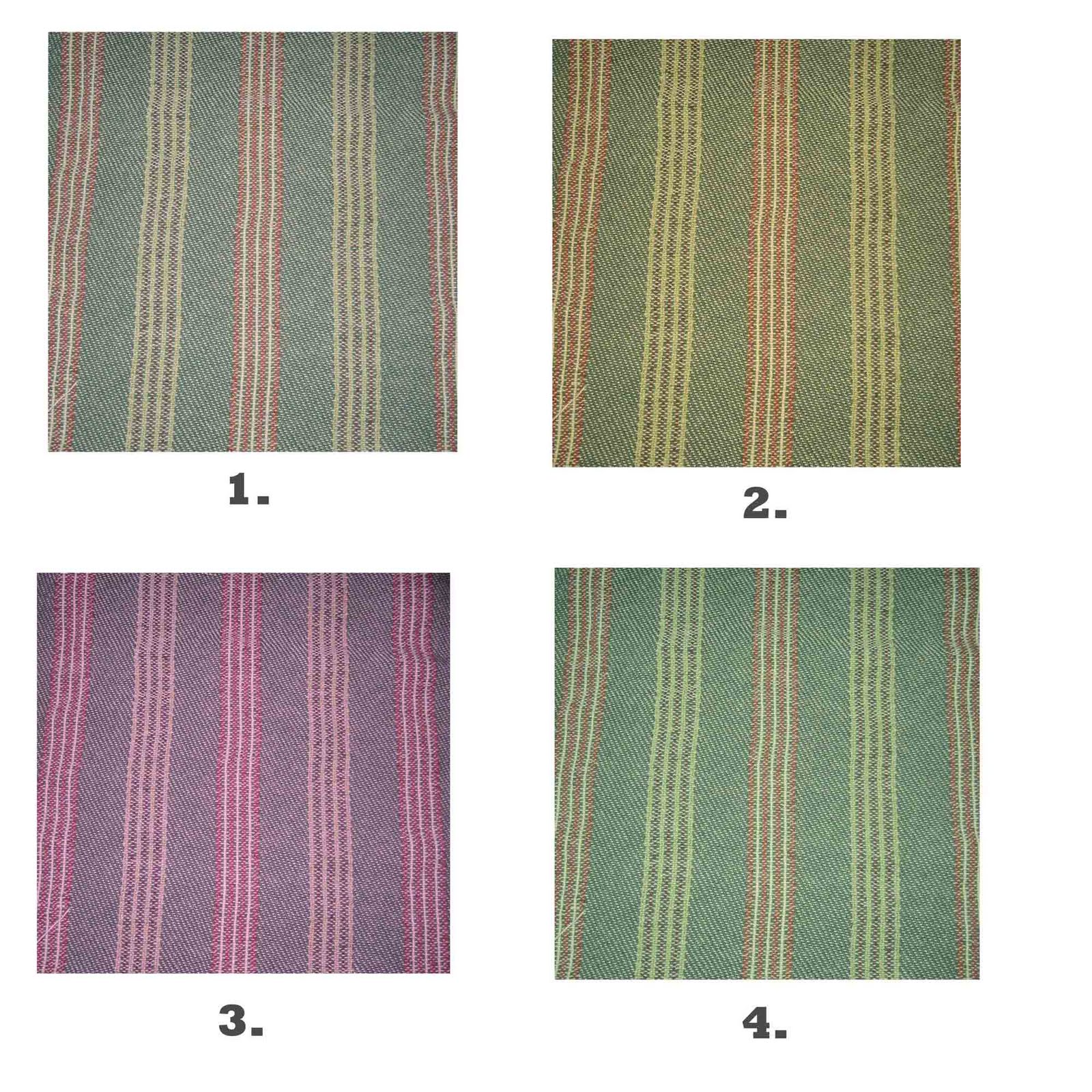
Jackie brought yardage to the meeting that she hoped to turn into towels for Christmas gifts. The original color of the yardage appears in photo number 1. She was disappointed that the colors weren't as vibrant as she hoped, so we did a photoshop overdye of her cloth to see what might happen in a dye bath. Photo number 2 is a yellow overdye, photo 3 is magenta and photo 4 is green. I think that number 2 and 3 are probably fairly accurate renderings of what an overdye of the cloth would look like. I'm not so sure about the green filter because the red still shows as red, but it is interesting to play with a photoshop technique before you actually commit the fabric to the dye pot.


Jackie also brought this luscious chenille shawl destined to be sold at Shawls Unlimited (they called it Night Shadow). It is a big shawl, with perfectly twisted fringe that would make the ultimate in a luxury gift. The warp and weft are rayon chenille.

Sue H. wove this yardage and is still thinking about what it will become. The main part of the yardage is the blue in the top of the photo, but I wanted to show some of the colorwork at the end of the piece. Will certainly become something wonderful.
Sue has also been weaving towels for sale. Here are several from the stack she brought to show. Sue weaves a couple of towels, cuts them off the loom and then ties on a new warp with a new color sequence for a fresh look.

Wednesday, November 18, 2009

What we are up to this fall

At a meeting this past August, we decided to weave scarves for teen age foster kids in our county that would be given to them as gifts during the holidays. To make it a bit more of a challenge, we set up an exchange of yarns hidden in brown paper bags. Each weaver was to use at least one of the yarns in the bag to weave one or two scarves. Using up to 50% of one's own yarn was permissable.

At the November gathering, several people were done with one or more of their scarves and some people had woven scarves for the gift giving that weren't part of the brown bag exchange. So interpersed with the show and tell from the November meeting, some of these lovely scarves will be on display here along with pertinent information on the draft, yarns used and problems encountered.

The scarf shown in this post was woven by Diana. She painted a neutral colored cotton chenille skein at a local dye workshop. The scarf was woven using the painted yarn as warp and the unpainted neutral as weft. And what a stunning, soft scarf it is. Diana washed and dried her scarf and was dismayed that the twisted fringe wormed. She did some research and found a suggestion on the web about braiding the fringes rather than twisting them -- which is the finish she settled on. We all agreed that the teenager that gets this scarf will love wearing it.

Stay tuned for more show and tell from the November meeting. I plan to keep the blog posts shorter and hopefully more interesting to our weaving readers.

Tuesday, August 25, 2009

August Meeting Part 3


Resuming where we left off in the August show and tell, is Dee's bag on the left woven with sari silk yarn. She knitted a closure and lined the bag with bright red material from an antique kimono. On the right is a bag entered by Sue H. which matches the vest later on in the post. Sue's bag is made of felted handwoven wools.


A blue ribbon winner if there ever was one, Dee's unlined wool jacket is trimmed with a crochet edging.


Dee found the perfect use for some novelty chenille like yarn. She used it in every other weft pick for this stunning shawl woven with wool and silk. Also note that she left the red warp threads loose and twisted the navy ends for something out of the ordinary. Rachel, from Shawls Unlimited, named this one Azadi


Here is another blue ribbon winner by Dee that was only on the Shawls Unlimited site for a few days before it disappeared! No wonder -- lovely wool spiced up with novelty ribbon yarns and a generous size made it easy to sell.

Here we have Sue H's vest that goes with the purse pictured earlier in the post. Sue fulled the fabric for this vest a bit more than she had intended and couldn't think of what to make from the yardage. But, she came up with this terrific looking vest. The binding is knitted with the same yarns used in the handwoven fabric, but naturally not fulled. Look for details in the construction of this vest in future post.

These eye catching towels were woven by Sue H. all on the same warp. This vibrant collection would make any kitchen come alive.


Back (left) and front (right) of Sue H's prize winning top. Each of the details in this top are repeated in another location, tying the whole together into a fabulous piece. The sleeve decoration which can just be seen in the right photo, has the same weft striping as the center panel. On the back, you see triangular detailing, which is repeated in the gusset under the arms.
Needless to say, the judge at the fair was very impressed with this garment.
Sue is a master of detailed finishing. This towel features a loop at each side of the center of the towel, which was woven as a weft thread. This handy loop makes it possible to hang the towel from a hook.
I still have a few more photos that really need to be shown. Look for part 4 in a few days.

Saturday, August 22, 2009

August Meeting Part 2


Carol's towels are both woven with a variegated slub yarn. Notice the amazing plaid created when the yarn crosses itself. The towel on the left has a lot of texture and is a waffle weave structure and the towel on the right is plain weave. However, because of the thick and thin nature of the yarn it also has a lot of texture.


Carol's beautiful huck scarf won a first prize. This was woven with Carol's two ply handspun yarn in angora and Merino. She used two different sources for the yarn, so there is a slight color variation and she alternated colors in both warp and weft to give a uniform appearance to the scarf.


It was hard to capture the colorful beauty of Carol's multi-color shawl. But I was so surprised when I held it up to the light in the picture below and found this glorious pattern that isn't so easily seen without the light going through it. The structure is again, huck lace, but it so different from the scarf in appearance. The warp is a rayon blend and the weft also rayon.


Carol used space dyed yarns for this wool plaid blanket. The weave structure is plain weave and the variation in the color of the yarn again gives great depth to the finished blanket.


Gus wove this rug after a workshop with Jason Collingwood a year ago. It now resides in her kitchen -- and what a beauty it is. The warp is linen and the weft is wool. Look for details of this rug in a future blog about finishing touches.


Gus wove this colorful red, black and white lap robe for an antique car that she and her husband restored. Gus used an 8 shaft advancing twill from a draft by Bonnie Inouye. I'm going to try to get pictures of the lap robe and the car together for a future blog post.

Thursday, August 20, 2009

Dog Days of August


Well, have you ever seen a cuter dog than Carl? Carl was the greatest greeter ever at Gus' home for our August meeting. He made each person feel totally welcome and everyone got an invitation to throw the ball for him.


Our group had such a lot of show and tell after the Nevada County Fair, that I'm dividing our meeting post into at least three separate posts so that readers will be sure to get all the glorious details from a fantastic meeting.


Diana brought this towel that she entered at the fair. She wanted to combine two different weave structures -- in this case huck and plain weave into one piece. Her colors are fabulous and we all agree this would be a perfect drying towel because of the open structure of the huck. Her one problem was that the plain weave didn't draw in as much as the huck leaving the selvedge with a slight bulge in the plain weave areas. We finally decided that there wasn't much she could have done about it except perhaps to use a finer thread in the plain weave sections. If anyone has ideas for Diana, please post them here.


Ingrid brought a sample for the napkins she is weaving on her new 24 shaft loom. The sample is 16 shafts on a point threading. She used a sett of 32 epi, but says she is beating at 40 ppi. We all thought that the sample looked great and didn't think that the sett needed adjusting. The napkins will be so fine and delicate. I think the cloth would make a fabulous christening gown and someone suggested wedding gown fabric.


Jackie brought two new shawls that she will be selling at Shawls Unlimited. The shawl in the photo above has a ring spun rayon warp. Jackie combined several different colors and weights of rayon and if you were to be so fortunate to see the shawl in person, you would see how much the slight color variation in the warp threads adds to the interest of the shawl. The weft is white alpaca and since the shawl was slightly weft faced, Jackie used 10 ounces of alpaca. This is a large shawl, worthy of cold weather wearing, if we should ever again be so lucky.


Jackie's other shawl is 100% alpaca. It is a two block twill design and the alpaca yarn uses is mixed gray and white. In a stroke of genius, Jackie outlined the changes in the twill blocks with a dark gray stripe. The overall effect (which is completely lost in this photo) is of a Navajo rug design.

This is blog post one of our meeting. I will put up another post in a few days because I still have lots of photos to edit. Hope I don't forget details about weave structures, etc.
Friday, June 19, 2009

Napkin Exchange

The napkin exchange finally took place after having been postponed for a couple of months. Here are the napkins Gus wove using the bumberet draft featured several blog posts ago. The colors for each set were different and she designed the stripe variations as she wove.
Sue H. brought the colorful stack of napkins pictured above. She used 8/2 cottons from her stash and warped two threads at a time in colors that were very close in color. This added attention to detail gives the napkins lots of color depth.

Sue R. wove these two pairs of napkins in soft, natural colors. Sue used her four shaft loom and even though Sue is a relatively new weaver, they are superbly designed.

Marcy's napkins were also woven on her 4 shaft loom. She used a different color weft on each pair and what a variety she came up with. My particular favorites were the set woven with dark red weft.

Diana brought three sets -- all different. If you look at past blog posts, you will find the source for the celtic knot pattern and for the blue and white design. The magenta napkins were woven as a sampling journey using different tie ups with her new 8 shaft Mighty Wolf.

This is one of Dee's napkins. It looks like a two block twill to me and if I'm wrong -- I'll correct myself. These look like they will be very absorbent and I added a pair to my collection.

These are one of my two sets (Beryl) and I have featured the material on Banner Mountain Textiles blog.

Dee brought this bag (the handle is still being knitted) that was woven with an 8/2 cotton warp and with one shot of Sari silk and one shot of cotton in plain weave. This technique made a more supple material than weaving the sari silk every shot.


At last month's meeting, Jackie showed us some textured yardage that she wove for a future garment. The 8 shaft draft is a two block threading. Block One 1-2-3-4 and Block Two 5-6-7-8. I've just posted the tie up here and you will see that the draft is a two block twill except that the diagonal lines are not turnd in direction. The effect in woven cloth is one of texture, rather than pronounced pattern. Dee wove two scarves and a shawl using this draft. The scarves were treadled 1-2-3-4-5-6-7-8.

For this fantastic shawl, Dee did treadle in blocks. The lines are faint between block changes , but more obvious when viewed from a distance.

Ingrid has promised that her napkins will be forthcoming and she will do trades with several people once they are completed. By the way, her towels in the slide show were woven on her new 24 shaft loom but they are a 16 shaft point twill design (they are the dark green and white diamonds).

Be back next month for more virtual "show and tell"

Tuesday, May 19, 2009

May Gathering

We met for the first time at Kerry's studio at her Alpaca Ranch Kerry also sells yarns and equipment, so there was a lot to see before we settled into the meeting.


Kerry brought out a weft ikat sample that she did in a workshop with Mary Zikafoose. The pattern is planned and the yarn resisted and dyed so that color changes will fall into a pattern as it is woven. It is hard to get the pattern to fall exactly where you planned and Kerry says that you need to constantly adjust your weft yarns as you weave.


Kerry is working on this Navajo style tapestry in her studio. The work is beautiful -- but oh, so slow to weave. Below is a shot of the small loom she is using. We asked Kerry if she sat on the floor as she wove -- but no, she places the loom on a table and sits in a chair. Well, I guess we didn't really expect her to be that authentic in her weaving style!


Diana told us about her Theo Moorman inlay place mats at our last meeting. Now, she has woven four of them and says the process has become much more intuitive for her. With images all marked for each item in the place setting, Diana hopes they will help her young granddaughter learn how to set the table. With the assistance of a cartoon, Diana managed to get the plate and glass markings woven into almost perfect circles. Great job! If you are lucky enough to have the a collection of old Handwoven magazines, the directions are in the Sept/Oct 1992 issue on page 35.

Carol came back full of news about the CNCH conference that was held in Sonoma this year. She took a class called "Oh, Dry Up" with weaver, Joanne Tallarovic. The class covered Swedish towel structures and techniques. The samples below are woven in a rep weave technique. The warp and weft are 8/2 cotton and the tie down weft is sewing thread. I believe this is a two block design. A thorough explanation of the process is in Joanne's book Rep Weave and Beyond

Carol came back from her class with a big binder full of samples and drafts for future reference. The green and white sample below is false damask. When this is woven in multiple colors, there is a wonderful ribbon effect of colors going over and under one another. On my list to try!


Jackie has a stash of 16/2 cotton and thought she would kill two birds with one stone. Get rid of
some of her fine thread stash and weave yardage for a lightweight top. She found an interesting draft in Carol Strickler's book of 8 shaft patterns and once weaving was underway, she discovered that it was going to be a textured piece of cloth. There are two similar value colors of thread so enlarge the picture so you can see it a bit better.

I have playing around with designing tie ups that will give a mock lace effect on a non-lace threading. In trying to explain myself at the meeting, I found I wasn't able to convey what I do to get a lacey effect by altering a twill tie up. I promised to put a draft together that would illustrate what I meant. Below you see a twill tie up that has little white and black crosses in it. These can be added or subtracted however you like in any twill tie up. In the drawdown, you see these little crosses appear in the cloth. The threading in this draft could be mirrored and repeated for an interesting design and treadling could be straight, point or tromp as writ.


Here is an example of a mock lace tie up for 20 shafts. The larger version makes it easier to see where I have added black and white crosses in the tie up. It is similar (but not identical) to the tie up I used for the shawl below.


Next month we are finally going to have our napkin exchange. Some of us are done weaving our napkins -- and some have found spring pulling us into our gardens doing other fun stuff. See everyone in June!